

Slab layout marking robot
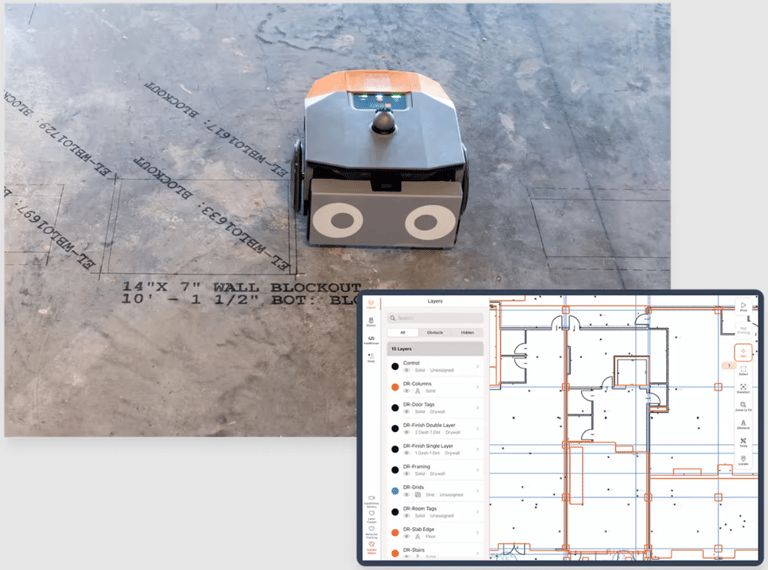
The digitalization of the construction industry is advancing rapidly, and one of the most interesting innovations in this process is the development of robots capable of printing project markings directly onto the jobsite floor.
Traditionally, the layout and marking of walls, installations, and construction elements are carried out manually by construction or surveying teams, using measuring tapes, lines, lasers, and printed drawings. This method can be time-consuming and prone to errors, especially in complex projects with a large number of elements.
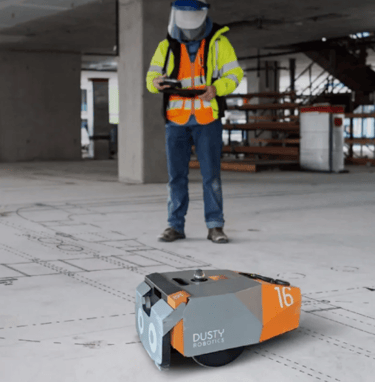
A new technology aims to solve this challenge by using mobile robots that receive data directly from the project’s digital model (typically from BIM platforms) and print all necessary markings directly onto the jobsite floor for execution.
How the technology works:
The robot moves autonomously across the jobsite floor and uses an industrial printing system to mark various key project details directly on the surface, such as:
wall and partition positions
structural gridlines
electrical and plumbing points
door and opening locations
identification of construction elements
These markings are executed with high precision, following exactly the coordinates defined in the digital model.
To ensure accurate positioning on-site, the equipment uses navigation sensors and positioning systems, allowing the robot to orient itself within the environment and perform the printing with a high level of accuracy.
Integration with digital projects:
One of the key differentiators of this technology is its direct integration with BIM (Building Information Modeling). Project data can be sent straight from the digital model to the robot, eliminating intermediate steps such as drawing interpretation or manual measurements. This creates a direct connection between the digital design model and the physical execution on the jobsite.
Benefits for construction:
The application of this technology can bring several advantages to the construction process:
greater precision in the execution of walls and installations
reduction of rework caused by marking errors
increased productivity of construction teams
improved integration between design and execution
reduced time spent on manual measurements and layout
In large-scale projects, automating this process can result in significant efficiency gains.
A trend in digital construction
The use of robots to transfer project information directly to the jobsite is part of a broader trend known as digital construction or Construction 4.0, which aims to integrate technologies such as BIM, automation, and robotics into construction processes.
As the industry continues to advance in digitalization, solutions that directly connect the digital world to the physical construction environment are expected to play an increasingly important role in improving productivity and overall project quality.
© 2025 Vitrine de Inovação. All rights reserved.
Follow us on Instagram as well
contato@vitrinedeinovacao.com
CNPJ: 65.902.817/0001-09