

Slipform (sliding formwork)
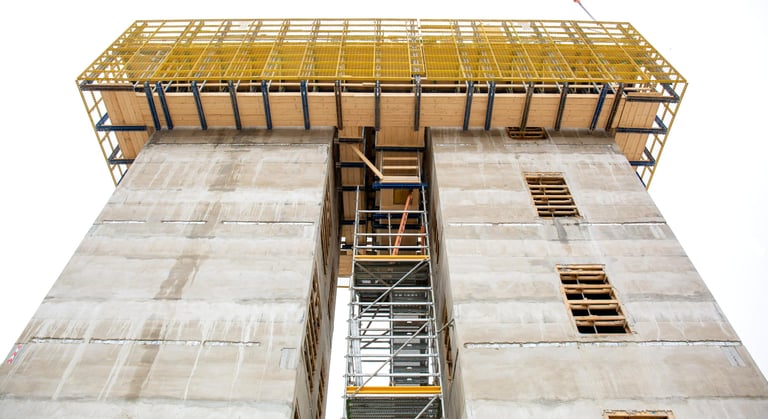
Slipform (or sliding formwork) is a construction system used to execute reinforced concrete structures through continuous pouring, allowing the structure to be shaped vertically without significant interruptions in the process.
In this method, the formwork is assembled around the structure and slowly moves upward using hydraulic jacks, while concrete is continuously poured at the base. As the concrete gains enough strength to support itself, the formwork system gradually rises, enabling uninterrupted execution.
This process creates a monolithic structure, reducing construction joints and increasing productivity on-site.
How it works
The slipform system consists of a set of equipment and platforms that operate simultaneously during concreting.
The process typically follows these steps:
Initial system setup: The formwork structure is installed at the base of the construction, along with working platforms, reinforcement, and the lifting system.
Installation of hydraulic jacks: Hydraulic jacks are connected to steel rods or bars that allow the gradual lifting of the entire formwork system.
Continuous concreting: Concrete is continuously poured into the forms. As the material begins to harden, the system is slowly elevated.
Gradual elevation of the formwork: The formwork moves vertically at an average speed of 15 to 30 cm per hour, enabling uninterrupted execution of the structure.
Throughout the process, teams work simultaneously at different platform levels, performing:
reinforcement installation
concrete placement
geometric control of the structure
surface finishing
Benefits for construction
The use of slipform offers several advantages for projects involving tall vertical structures:
High productivity: Continuous concreting can accelerate construction by up to 70% compared to conventional or climbing formwork systems.
Reduction of cold joints: Since concrete is poured continuously, interruptions are minimized, reducing the formation of construction joints.
Improved structural quality: The resulting structure is more homogeneous and performs better structurally.
Reduced repetitive labor: Eliminates the need for constant formwork dismantling and reassembly.
Enhanced operational safety: Integrated platforms provide organized and safer working conditions.
Practical applications
Slipform is widely used in vertical structures with repetitive or continuous geometry, including:
structural cores of high-rise buildings
industrial silos
industrial chimneys
telecommunication towers
elevated water tanks
dams and hydraulic structures
In high-rise construction, the system is especially efficient for executing elevator and stair cores, which concentrate much of the building’s structural stiffness.
Challenges and key considerations
Despite its advantages, slipform requires rigorous planning and high-level technical control.
Key challenges include:
logistical planning for continuous concreting
control of concrete workability and setting time
alignment and geometric control of the structure
need for specialized teams
continuous (24/7) monitoring during execution
Since the process cannot be easily interrupted, any operational failure can directly impact structural quality.
With advances in construction technology and the growing demand for taller buildings, systems like slipform are gaining prominence due to their efficiency and productivity. Integration with monitoring sensors, digital concreting control, and BIM modeling is expected to make this system even more precise, safer, and more efficient—consolidating it as one of the most advanced solutions for vertical concrete structures.
© 2025 Vitrine de Inovação. All rights reserved.
Follow us on Instagram as well
contato@vitrinedeinovacao.com
CNPJ: 65.902.817/0001-09