

Transparent wood


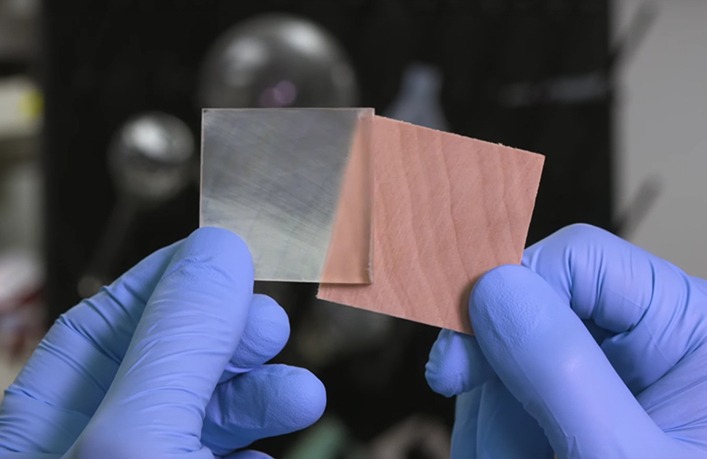
The search for sustainable, high-performance, and low environmental impact construction materials has driven the development of new technologies based on natural resources. A promising example is transparent wood, currently being developed by researchers at KTH Royal Institute of Technology.
This material is a composite derived from structural modification of natural wood, specifically through the selective removal of lignin—one of the main components responsible for wood’s color and opacity. After lignin extraction, the remaining porous structure is impregnated with a transparent polymer, resulting in a material with high diffuse light transmittance, enhanced mechanical strength, and improved thermal and acoustic properties.
Unlike glass, transparent wood has lower density, better insulating performance, and reduced risk of fracture, making it a viable alternative for various applications in architecture and construction. Potential uses include translucent façades, structural skylights, interior partitions, and windows with controlled light transmission.
Beyond its technical properties, this material aligns with bioeconomy and sustainable construction principles, as it is derived from a renewable source, has a lower carbon footprint, and can reduce electricity consumption by enhancing natural lighting.
Although still in the research and development phase, transparent wood represents a significant advancement in materials engineering, with the potential to become part of the portfolio of smart materials for future construction. Its evolution follows a global trend of reengineering natural materials, focusing on energy efficiency, functional performance, and environmental sustainability.
© 2025 Vitrine de Inovação. All rights reserved.
Follow us on Instagram as well
contato@vitrinedeinovacao.com
CNPJ: 65.902.817/0001-09